| Coastal
erosion and management: Sitges, Barcelona |
| Travel time: 15 minutes
|
|
|
Themes
|
Features
|
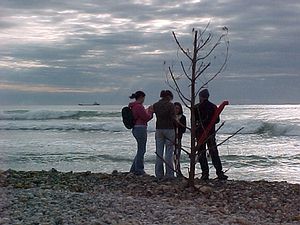 |
| Sitges shingle beach |
|
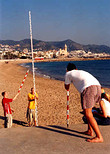 |
| Sitges sand beach |
|
Many Catalan beaches are losing their
sand. Recent storms have starkly revealed this problem and the long term
solution is a complex one.
This study investigates the coastal processes, management and issues focusing
on the threat to the Sitges beaches.
Evidence for longshore movements and dominant wave directions can be gained
through a study of pebble long axes and alignments. Hypotheses can then be
applied to a study of the sand beach profiles.
|
Comparisons of shingle and sand beach
profiles.
Evaluation of the success of the current coastal management schemes.
This case study forms the focus of a recent Eurosion
report on coastal erosion and management.
|
 Sitges
coastal management Sitges
coastal management
|
|
|
|
|
|
|
| Conflict
on the coast: Platja Llarga, Vilanova |
| Travel time: 30 minutes |
|
|
Themes
|
Features
|
|
 |
| Planning development |
 |
| Platja Llarga |
|
This fieldwork assesses the beneficial economic impacts of the Platja Llarga
planning development against the environmental costs and examines the views of
stakeholders and their conflicting needs. Field study methodology includes the
use of conflict matrices, cost-benefit and values analysis and environmental
impact assessments.
|
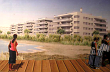
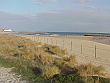
Platja Llarga was a large area of coastal wetland and dunes, forming part of the
delta of the River Foix. Today, although badly damaged, it remains one of the
last undeveloped sites along the Catalan coast.
|
|
Platja
Llarga
|
|
|
|
| Ebro
Delta: Mediterranean wetland issues and management |
| Travel time: 1¼ hours |
|
|
Themes
|
Features
|
|
 |
| Dunes |
 |
| Rice paddy |
|
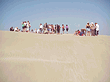
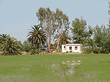
Mediterranean wetland issues and management.
This study includes threats caused by increased
urbanisation, tourist developments, aqua culture, river management and the National
Hydrological Plan.
|
Primary data collection includes environmental impact
assessments. The Visitors' Centre provides an audio-visual presentation upon
arrival.
A boat excursion to the delta mouth forms one of the
highlights of the day.
|
Ebro
Delta Natural Park management
|
|
|
|
| Sand
Dune Management: Gavà |
| Travel time: 30 minutes |
|
|
Themes
|
Features
|
 |
| Managed dunes |
 |
| Unmanaged dunes |
|
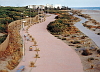
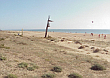
The impact of human activity, the variations in biodiversity between managed and
unmanaged dunes, and the success of dune management schemes. Contrasts may be
drawn with the protected sand dunes at the nearby Llobregat Delta Nature
Reserve. |
This fieldwork investigates the threats to fragile sand dune ecosystems along
the coastline to the southwest of Barcelona. The construction of the Gavà
coastal walkway aims to protect the dune ecosystem mainly by reducing extensive
trampling. |
Management
of fragile coastal ecosystems |
|
|
|
| Sand
Dune Vegetation Succession: Llobregat Delta |
| Travel time: 30 minutes |
|
|
Themes
|
Features
|
 |
| Llobregat Delta |
|
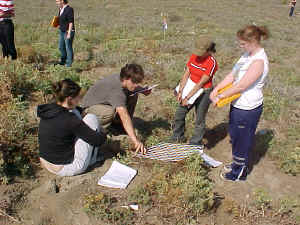
Vegetation succession. Measurement of abiotic variables, distribution and
abundance of plant species from pioneer zone to climax community. |
The study includes a climax community problem-solving exercise. Option to
consider modification of the coastal ecosystem by human activity. |
Vegetation
succession at the Llobregat Delta
|
|
|