
Priorat: environmental impact of the wine revival
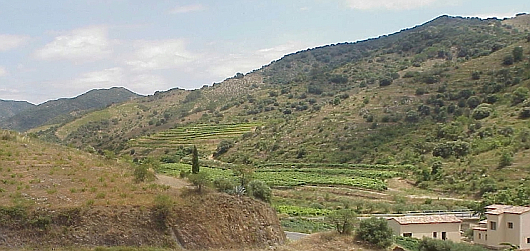 |
| Sustainable terracing examples in Priorat |
The outsiders who brought modern winemaking to the region may have put Priorat on the map, but when they planted new vineyards, they built wide terraces that could support tractors, not realizing until later how terraces could cause erosion and disrupt the land's natural water retention.
The steep relief of the Priorat region and the typical Mediterranean climate with torrential downpours often reaching 100 mm in a few hours makes the area very vulnerable to soil erosion. Traditionally, wine growers have overcome these adverse conditions by constructing small dry stone walled terraces to reduce the natural slope of the land. This technique, based on plentiful and cheap labour, has created a characteristic and highly valued landscape, attracting wine tourism.
| Functions of Terracing |
|---|
|
• Keep the soil and retain water. The primary purpose of the
terraces is controlled evacuation of rainwater, so as to avoid soil erosion as
much as possible. |
However, traditional hand-built dry stone terracing is no longer economically viable. One of the main techniques for increasing productivity in Priorat is industrial terracing that allows for the mechanization of farming. The characteristics of Priorat viticulture and the environmental problems created by industrial terracing are summarised below.
| Priorat mountain viticulture |
|---|
|
• The average gradient is 46%. |
| Environmental problems caused by modern terracing | ||
|---|---|---|
|
• Impact on the landscape. The wider terraces tend to break
the harmony of the landscape producing an industrial 'quarry' effect.
|
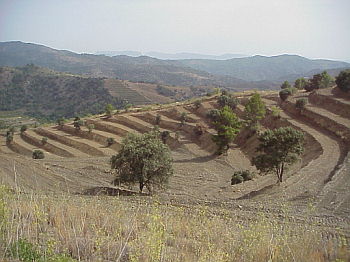
| Process of water erosion |
|---|
|
Erosion by water operates through two basic mechanisms: • Impact of raindrops. If the rain is very intense, the force
of raindrops destroys components of the soil structure. This process is
accompanied by a decrease in porosity. The erosive power of water is heightened
by long periods of drought which leaves the soil dry, cracked and devoid of
vegetation cover that helps mitigate the impact of downpours.
|
| Negative impacts of soil erosion |
|---|
|
Among the many negative impacts of erosion include: • Reducing the thickness of the layer of soil on the plots
affected.
|
New Environmental Regulations
Recently, as the people in the region have witnessed the environmental challenges created by the rush to build terraced vineyards on ever-steeper hillsides, new regulations have been passed. Terraces are forbidden on the steeper slopes, and at least 40% of the natural vegetation must be preserved. Guidelines for sustainable terracing including terrace design criteria, are summarised below.
| Sustainable terracing in Priorat | ||
|---|---|---|
|
Environmental problems of industrial terracing can be overcome if adequate design criteria are implemented. The risk of erosion is not a function of the natural slope of the terrain, but the design of the terraces: a poorly designed vineyard on a slope of 25% will have more erosion that some well-designed terraces on a slope of 50%. • Harmonious integration of the terraces in the landscape,
with the height of embankments limited to 1.5 m to reduce visibility and a
'quarry' effect.
• The length of the terraces is limited to 200 m, in order to
avoid erosion. Half of the terrace (100 m) drains into a canal and the other
half, toward the opposite channel.
|
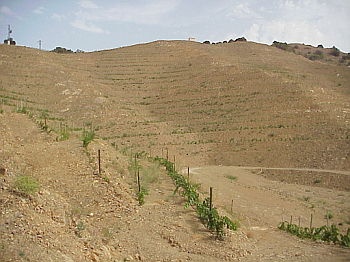
Wine Farms or Wind Farms?
The revival of the region has shown the value of maintaining mountain viticulture and social and political mobilisation backed by the vinicultural sector managed to halt a government plan to convert Priorat into a major wind-power producing centre. Priorat alleged that the plan was incompatible with the project designed to foster the quality of the wine and landscape. The Priorat has begun to debate its development model while, in the meantime, the region's main mountain range, the Serra del Montsant, has been declared a Natural Park. The debate has begun and time will tell.
 |
| Wind farm overlooking the village of Pradell de la Teixeta in Priorat |
| The importance of maintaining mountain viticulture |
|---|
|
• Maintains economic activity and prevents rural
depopulation. |