
Priorat: Social, Demographic and Economic Impact of the Wine Revival
Thanks to its wines, the Priorat now believes in something. There are young people who, for the first time in one hundred years, are returning to the country in response to a peasant-farming vocation. There are schools that, for the first time in living memory, have a growing intake of pupils. Sparkling new wineries are opening in villages where nothing had opened for a century or more. Rural tourism that follows the wine route is gradually beginning to make its presence felt. Hotel accommodation and restaurants are making their debut. Years ago, everybody in Catalonia knew that the Priorat produced wines. Now the exceptional wines of Priorat are well known around the world and the revival of the region has shown the value of maintaining mountain viticulture.
| The importance of maintaining mountain viticulture |
|---|
|
• Maintains economic activity and prevents rural
depopulation. |
Changing Social Dynamics
Priorat has experienced a stable demographic trend in the last
few years with an upwards orientation. The evolution of the population
2001-2005, is affected by the influx of two main population profiles:
1. persons of urban origin
2. a foreign population arriving in Priorat to work in the agricultural sector.
| Evolution of the
population according to place of birth 2001-2005 |
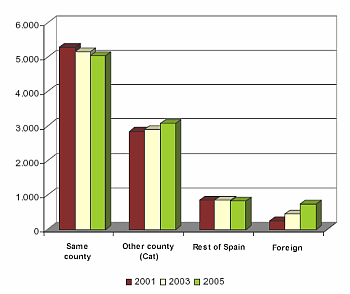 |
A number of relationships may be explored between the population place of birth and economic development in Priorat, including the positive correlation between the percentage born in the rest of Spain and the number of wine cellars found in each Priorat town.
There has been an increase in the working population and a reduction in unemployment, with a progressive integration of the job market from the increasing influence of the Tarragona-Reus coastal core region.
As late as the 1980s, only one single-lane road connected Priorat's crumbling medieval towns to the rest of Spain. Accessibility to the coast has improved in the last decade, but continued limitations in infrastructure create difficulties for the transformation of the region, illustrated in the diagram below.
Social Dynamics: the difficulties of creating transformation in the Priorat region
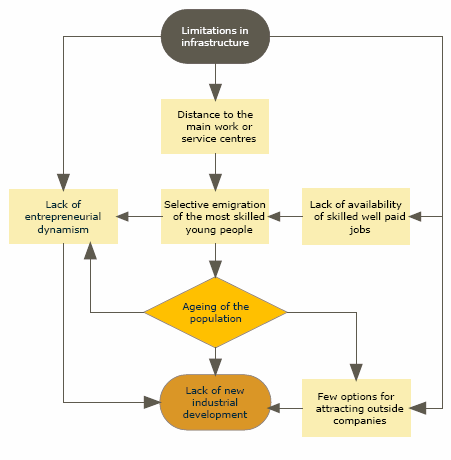
It is not easy to attract customers nor skilled workers to the region, but its very remoteness is a key to its recent revival. Priorat bypassed the era of mass-produced wines that dominate the more accessible parts of Catalonia and as a consequence, has been well placed to take advantage of recent changes in consumer tastes. For discretionary purchases, consumers have increasingly rejected the industrial 'fordist' model of low cost mass production, trading up where the product is aspiration or trading down when the product is only function. As a consequence, demand has soared for high quality, individual organic wines, produced from small vineyards whose annual output often amounts to just five thousand prized bottles.
Consolidating Social and Economic Development
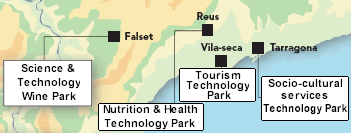
To try and ensure that quality is maintained, innovations continue, and wines stay ahead of the competition, Europe's first Science and Technology Park specialising in wine research and development opened in 2009. Its location will be Falset, the heart of the Priorat wine growing area. The Park will be of critical importance in guaranteeing the continued social and economic development of the region.
| Priorat Science Park of Wine Technology | ||
|---|---|---|
|
A Science Park of Wine Technology opened in 2009 in Falset, the heart of the Priorat wine growing area. It is intended as an international centre of wine research and development, ensuring the region continues to stay ahead of the wine competition. It includes a series of pilot plants and facilities to assist new business start-ups. The Wine Technology Park is one of four new tourism-related Research and Development institutions in the region.
|
Food or gastronomic tourism trends