
Fumanya Dinosaurs
The exploitation of opencast lignite in Fumanya has revealed outcrops of extraordinary dinosaur footprints, the world's largest outcrop of Maastrichtian sauropod tracks. The footprints were originally created on a former calcareous lake bed which has since been uplifted to form an impressive 50,000 square metres rock face. This provides a panoramic view of thousands of traces of dinosaur footprints of various types and sizes preserved in the rock. There are traces that can be followed up to 50 metres long. Footprints of titanosaurs are predominant, a characteristic of the Maastrichtian sauropod. Titanosaurs, large herbivores of the Upper Cretaceous, were some of the heaviest creatures ever to walk the earth, and may have weighed up to 100 tonnes. The 3,000 dinosaur footprints found at Fumanya place this site as the first in Europe and third in the world in number of tracks after the Lark Quarry (Australia) and Chaoyang (China).
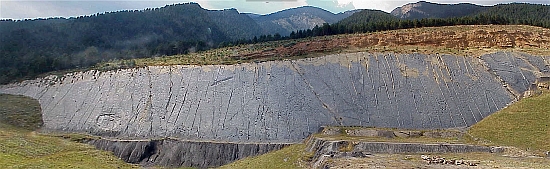 |
| Panoramic view of the titanosaur dinosaur footprints at Fumanya |
Geological description
The succession of exploited coal seams are found at the bottom of the continental facies series of Garumnià (Maastrichtian - Paleocene), corresponding to the St. Cornelius marl. It belongs structurally to the lower Pedraforca thrust sheet. The depth varies from 600 metres in the north, to 100 metres in the south.
 |
|
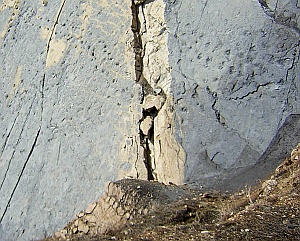
| Coal deposits adjacent to dinosaur tracks at Fumanya |
The series starts on the Maastricht levels of fine grain light grey marine limestones, corresponding to the first continental-brackish conditions of sedimentation in the basin.
These deposits contain carbonaceous plant remains spread throughout the basin with a depth of between 5 and 15 metres. The location within the Pedraforca lower thrust sheet during the Early Eocene led to internal structures and folds. Because the direction of plate movement is mainly north-south, the folds and internal structures have an E-W axis direction. The western end of the lower Pedraforca thrust sheet is in the form of an oblique ramp orientated NE-SW. The structures associated with this ramp have the same direction. The intersection of the two directions gives rise to interference folds: an anticline in the NS axis of the Llobregat and two basins on either side: the Nou (eastern) and the Vallcebre (west).
Importance as a geological record
The Fumanya site reveals sedimentary facies and processes at the bottom of the Garumnià coal beds.
It also shows the processes of diagenetic transformation of carbonaceous sediments in lignite and highlights the issues of economic geology and mining.
 |
|
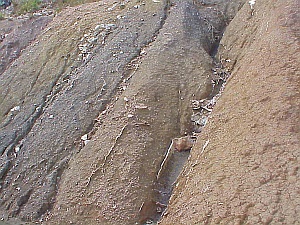
| Gypsum deposits at Fumanya |
Historic significance
Major coal mining operations began with Carbones de Berga SA. Maximum production was reached in the 1960s but it was not until 1965 that mining operations were mechanised. Decline began in the 1970s resulting in the closure of the Vallcebre and Fígols mines. Several projects have been initiated to revive the area, the most important of which is the Museum of Mines at Cercs.
Preservation
The Fumanya dinosaur site is included in the Cadí Moixeró National Park and therefore enjoys some protection from unwanted developments. In addition, several projects are planned by Carbones de Berga SA in their restoration of the quarry site. These include a visitors' centre, life-size replicas of the dinosaurs and the protection of the footprints using resin. UNESCO has accepted the nomination of Fumanya as a World Heritage site. The site remains hidden, is not signposted and is currently little known or visited.
Negative impacts and threats
The main problem is the gradual erosion and destruction of the surface of the tracks. Carbones de Berga SA initiated several protection trials using different types of resins but with little success and successive layers and traces have already disappeared. Work has currently been halted on the visitors' centre.
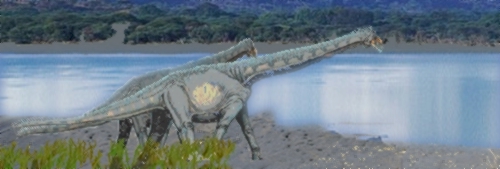 |
| The Fumanya lakeside environment 65-70 million years ago |
| Based on life restoration of Alamosaurus: Wikipedia |
Source: Albert Martínez Rius, Generalitat de Catalunya Departament de Medi Ambient