
The Garraf Natural Park: the management of a natural environment
Management Aims
-
To protect, conserve and improve the natural and rural environment of the Garraf Massif.
-
To ensure the compatible use of the Park's resources by its inhabitants.
-
To manage the resources of geology, flora, fauna and ecosystems not as isolated elements but as a complex interrelated system that reflects the long history of human exploitation of the area.
-
To provide and regulate the road network, footpaths, guided trails and other services for visitors and inhabitants.
The Natural Park of the Garraf lies between the lower valley of the river Llobregat, the Mediterranean sea and the Penedés Depression. The greater part of the Park was declared a Natural Park in 1986. The scenery is unusual, with rounded hilltops and deep, sheer-sided valleys. The predominant limestone rock is dotted with a type of Mediterranean maquis and garrigue vegetation, consisting of dwarf fan palms, kermes oak, mastic trees and the pampas-like grass, Ampelodesmos mauritanica. Features typical of karst landscapes include numerous caves and sinkholes, dolines, karren, and several underground rivers which discharge large quantities of fresh water below the surface of the sea.
The Park itself is virtually uninhabited. The population inside the Park is as shown:
Population
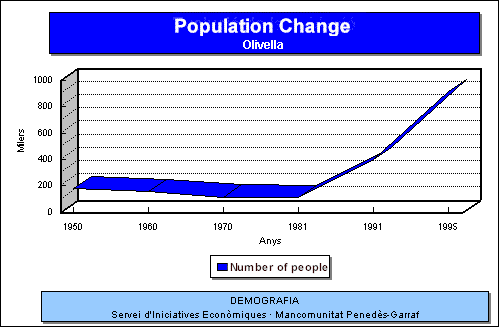
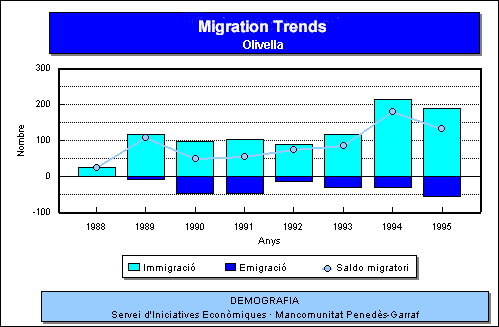
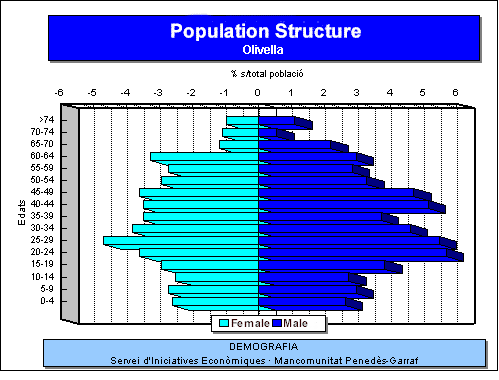
There are also 40 temporary inhabitants employed in La Plana Novella, mainly at the Tibetan Buddhist Retreat. Population and socio-economic changes in the wider Olivella area are shown below:
Migration
Population Density (km²)
|
Type of Occupancy
| Dwelling Type | Municipality | Region | Catalunya | |||
|---|---|---|---|---|---|---|
| 1981 | 1991 | 1981 | 1991 | 1981 | 1991 | |
| Principal Home | 6.4 | 15.0 | 50.7 | 49.6 | 71.6 | 70.9 |
| Secondary Home | 91.2 | 83.7 | 36.8 | 41.0 | 13.5 | 17.2 |
| Vacant | 2.4 | 1.2 | 12.5 | 8.9 | 14.9 | 11.6 |
| Others | . | 0.1 | . | 0.5 | . | 0.3 |
| Total dwellings | 591 | 946 | 39.005 | 49.486 | 2.452.869 | 2.721.383 |
Occupational Structure
| Sector | Municipality | Region | Catalunya | |||
|---|---|---|---|---|---|---|
| 1986 | 1991 | 1986 | 1991 | 1986 | 1991 | |
| Agriculture | 23.7 | 6.9 | 4.4 | 3.2 | 4.9 | 3.7 |
| Industry | 16.9 | 25.0 | 36.4 | 30.2 | 35.7 | 36.2 |
| Construction | 6.8 | 15.3 | 9.6 | 12.4 | 5.3 | 8.2 |
| Services | 40.7 | 52.8 | 45.8 | 54.2 | 45.6 | 51.9 |
| Others | 11.9 | . | 3.8 | . | 8.5 | . |
| Total occupations | 59 | 144 | 21.029 | 27.213 | 1.839.097 | 2.255.430 |