
Expand All | Collapse All
 
Why Barcelona?
Endorsements
Why Barcelona?
About the Centre
About the Centre
Administration
Brochure
Centre Fact Sheet
Classroom Support
Code of Practice
Company
Contacting Us
Courses
Equipment
FAQ
Financial Security
Forum
Inspection Visits
Music Tours
Office Location
Postcard Galleries
Privacy Policy
Publications
Slide Shows
Site Map
Site Uptime
Staff Vacancies
Test Users Online
Value of Geography
Visit Evaluation
Visitors' Book
Visitors Online
What's New?
Accommodation
Accommodation
Hotel Arcadia
Hotel Arcadia
Hotel Menu
Hotel Rules
Risk Assessment
Hotel Victoria
Hotel Victoria
Hotel Rules
Risk Assessment
Location Map
Booking
Availability
Provisional Booking
Booking Conditions
Confirm Booking
Small Groups
Prices
2011
Prices
Pricing Policy
Booking Changes
Combined Groups
2012
Prices
Pricing Policy
Booking Changes
Combined Groups
Field Study Locations
Barcelona Industry
Barcelona Rural
Barcelona Urban
Coastal Locations
Collserola Park
Ebro Delta
Garraf
Garrotxa
Les Garrigues
Llobregat Delta
Location Map
Montseny
Montserrat
Priorat
River Locations
Vall de Nuria
Field Study Options
Agriculture
Biology Fieldwork
Business Studies
Climate
Coastal
Ecology
Ecosystems
Environmental Impact
Geology
Glaciation
Government & Politics
Hazards
Industry
Issues
Landforms
Limestone
Pollution
Rivers
Rural Change
Rural Depopulation
Rural Rebranding
Settlement
Slopes
Soils
Tourism
Urban
Volcanic Landscapes
Water Supply
Fieldwork Methodology
Data Presentation
Methodology
Sampling
Techniques
Fieldwork Support
Classroom Support
Coursework Examples
Coursework Helpline
Site Data
Password Protection
Health and Safety
Culture Issues
Emergencies
Fieldwork Code
Foreign Office Advice
General Advice
Hotel Security
Language Survival
Planning
Risk Assessments
Risk Management
Safety Issues
Student Safety
U.K. Guidelines
Itineraries
Art
Biology
Business Studies
Combined
Ecology
Geography
Geology
Government & Politics
Spanish Language
Planning your Visit
Getting to Barcelona
Visit Preparation
What to Bring?
Syllabus Options
AQA A
AQA B
Edexcel GCE
GCSE
Intern'al Baccalaureate
OCR A
OCR B
WJEC
Syllabus Checklist
Extended Learning
A Level
GCSE
Geography Tests
Glossaries
Google Maps Compass
Map Reading
OS Maps Compass
Virtual Compass
Year 7
Year 8
Year 9
Password Protection
Other Activities
Culture and History
Geographical visits
Language Courses
Leisure
Music Tours
Tapas Meal
Walks
News
Current
News Feeds
Archives
Links
Currency Converter
Geography Links
Other Links
Related Resources
Satellite Map
Weather
Home Page
May 17, 2012
Availability | Prices 2011 | Prices 2012
 

Sagrada Familia

Work began on Barcelona's Sagrada Família (Temple of the Holy Family) in 1882, based on a design by Francisco de Paula Villar, who envisioned a simple church in a traditional neo-Gothic style.

But after he resigned in 1883, Gaudi was appointed the lead architect and redesigned the church entirely. His imaginative plans included 18 spires and five naves, rich with decorated organic detailing.

In 1911, the devout Catholic devoted himself entirely to the project, and spent the next 15 years living and working on site as a virtual recluse, supervising work. He died in 1926, after being run over by a tram. Since then different architects have continued the work after his original idea.

It has always been an expiatory church, which means that since the outset, 125 years ago now, it has been built from donations. Gaudí himself said: "The expiatory church of La Sagrada Família is made by the people and is mirrored in them. It is a work that is in the hands of God and the will of the people."

Although incomplete, the church is a UNESCO World Heritage Site visited by millions, and it will become the world's tallest church when the 170m (560ft) central tower is erected.

In November 2010 the church was consecrated and proclaimed a minor basilica by Pope Benedict XVI.
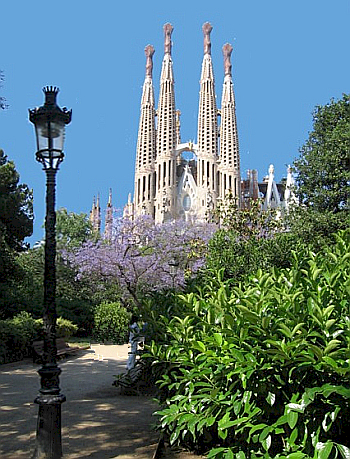
Sagrada Familia
Sagrada Familia


  Copyright © 2012 All Rights Reserved Barcelona Field Studies Centre S.L.  
Page update 26/02/11