Government and Politics A level: Catalonia and Spain - the State we're in
Residential course in Catalan
nationalism and Spanish democracy
INTRODUCTION
The course has been designed by John Barrass using Barcelona as a base to explore the ideologies of socialism, fascism, anarchism and nationalism that fuelled the Spanish Civil War. It aims to develop a greater understanding in and enthusiasm for the study of politics and supports the Edexcel syllabus for Advanced GCE in Government and Politics. Its key elements are applicable to other examination board courses and examinations in these disciplines. The course combines classroom teaching, audio-visual support and site visits.
DAY 1. Nationalism, Nation State, Economy and Politics This day includes site visits in Barcelona and explores:
OPTIONAL VISIT: Museum of Catalan History.
DAY 2. Anarchism in Barcelona Barcelona represents the one occasion in history when the anarchist movement has controlled a great city. Its experience during the Spanish Civil War is used as a vehicle to explore the concepts of anarchism, nationalism, socialism and fascism. The Spanish Civil War, a war fought for ideology, presents the world's best example of anarchism as a large scale political force. This day includes site visits in Barcelona and explores:
SITE VISITS: George Orwell's sniper post on Las Ramblas, shrapnel façade of Felip Neri, Liceu Opera House (anarchist bomb), Central Post Office, CCOO and UGT union headquarters, Foment de Treball patronal and the fortress of Montjuïc. OPTIONAL VISITS: air raid shelter on Avinguda Paral.lel. Palau Güell townhouse (before the industrial barons took refuge from their employees up in the hills).
DAY 3. Battle of the Ebro and the
Spanish Civil War museum
The battle of the Ebro was one of the most decisive engagements
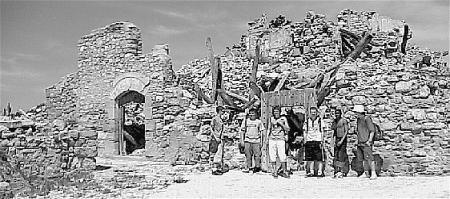
of the Spanish Civil War. This day includes a visit to Corbera d'Ebre, the old
town bombarded and preserved as a monument, and to the Civil War museum in
Gandesa where a wide range of resources help explore the conflicts between the
ideologies. Optional visits can be made to a series of Ebro battle trenches and
the site of the strategic river crossing by Republican troops at Miravet.
|