
LEDC Case Study: Intensive Wet Rice farming
Subsistence Rice Farming in the Ganges Valley, India
Categories: intensive, subsistence, arable
The Farm as a System
| Inputs | Processes | Outputs |
|---|---|---|
|
Five month growing season Temperatures over 21°C Monsoon rainfall over 2000mm Flat land flooded Dry time for harvesting Heavy alluvial or clay soils to provide an impermeable layer Large labour force Water buffaloes for ploughing Rice seeds annual floods deposit rich layers of alluvium (silt) |
Ploughing Planting Harvesting Threshing Weeding |
Rice Manure from buffaloes for fertilising Rice seeds |
Problems of Rice Growing
- Flooding – provides water and fertile silt to grow the rice but sometimes disaster strikes when the floods are so severe that they destroy the rice crop.
- Drought – in some years the monsoon rains 'fail' and the rice crop is ruined.
- Shortage of land and a growing population – many farms are too small to support the family. The ever-increasing population makes the situation worse. Food shortages are a real problem.
- Little use of machinery or modern methods.
- farmholdings are broken up into tiny plots and spread over a wide area. This makes efficient farming difficult.
- The majority of the best farmland is held by a few wealthy landowners.
- Many of the poorer farm labourers have no land at all and work within a latifundia system where they rent small plots, giving 60% of their output to the landlord and in addition having to work on the landowner's land for free.
Changes to Rice Growing in the Ganges Basin
1 The Green Revolution:
- The use of HYVs or high yielding seed varieties, such as IR8, more than trebled food production, giving higher average yields and allowing double or treble cropping;
- Greater use of fertilisers, tractors and mechanised ploughs;
- Grants and loans to buy new seeds and equipment.
But there are both advantages and disadvantages:
| Advantages | Disadvantages |
|---|---|
|
Yields increased three times; Multiple cropping; Other crops grown which varied the diet; Surplus to sell in cities creating profit; Improving standard of living; Allows purchase of fertilisers, machinery. |
Poor farmers could not afford HYVs, fertilisers and machinery; Some borrowed and ended up with large debts; HYVs need more water and fertiliser, which is expensive. Eutrophication caused by the increasing use of fertilisers. |
2 Irrigation:
Despite the monsoon rains the water supply can be quite inadequate for growing rice, especially if more than one crops is grown. Irrigation is a must for farmers.
In the Ganges Valley there are:
- Wells: holes are dug to reach underground water supplies, the water is then lifted from the well using a shaduf or a waterwheel or by modern electric pumps – the water is then fed along open channels to the field;
- Inundation canals on the riverbanks, which fill up as the river floods and take the water to the fields.
- Terraces can be constructed on sloping land to allow gravity-fed irrigation and help prevent soil erosion.
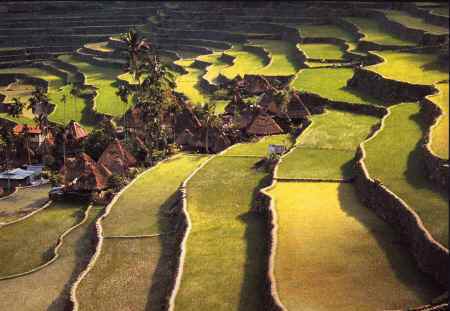 |
Terracing and gravity-fed irrigation
3 Appropriate Technology:
This technology is suited to the needs, skill, knowledge and wealth of people. Large expensive irrigation projects and dams have many disadvantages. Appropriate technology is needed, for example,
- Individual wells with easy to maintain, simple pumps
- Renewable energy sources which use local resources, e.g. wind, solar, power, biogas
- Projects which use local labour rather than machinery
- No hi-tech machines needing expensive fuel and foreign spares
- Low cost schemes, which are sustainable.
4 Soil Conservation:
To stop the erosion of top soils, conservation schemes are needed:
- To build terraces on sloping land
- To plant cover crops and windbreaks
- Add manure and straw to soil.
5 Land Reform
The aim of land reform is to:
- increase farm size for small landowners
- set an upper limit on the amount of land owned by the wealthiest landowners
- give surplus land to the landless farm labourers