
A Greenhouse effect has cooled the climate of Almería
Since the 1980s, Almería in southern Spain has developed the largest concentration of greenhouses in the world, covering 26,000 hectares. The greenhouses reflect so much sunlight back into the atmosphere that they are actually cooling the province, Spanish researchers have found. While temperatures in the rest of Spain have climbed at rates above the world average, meteorological observatories located in the so-called sea of plastic have shown them moving in the opposite direction, with a decline of 0.3 degrees per decade. The strange phenomenon had not gone unnoticed in scientific circles, and now a study has suggested a plausible explanation: the white colour of the plastic reflects sunlight into the atmosphere as if it were a mirror, and it slows the warming of the surface. In this way, the greenhouses at a local level offset the rising temperatures associated with global warming.
| Almería: the Sea of Plastic |
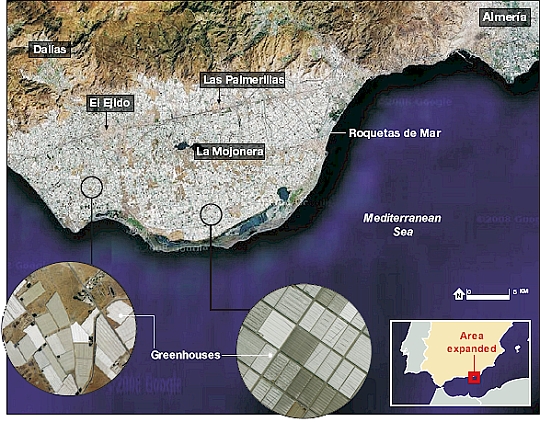 |
| Source: American Geophysical Union and Google Maps |
The work, which has just been published in the Journal of Geophysical Research, has been coordinated by a group of researchers led by Paul Campra, a professor at the University of Almería (LAU) assisted by Monica Garcia, Yolanda Canton and Alicia Palacios.
During the first phase of the study, temperatures of the two major weather stations in the area, Las Palmerillas-Cajamar and La Mojonera, were analysed and compared with those from other stations immediately adjacent to the region. The result was that temperatures in the region have fallen by an average of 0.9 degrees since 1980, when greenhouses expansion began, while in Malaga, Granada and Murcia-San Javier the increase has varied between 1 and 3 degrees. Thus there has been a difference of more than two degrees. There have been no significant changes in rainfall.
Temperatures at Almería airport increased during the 1980s, but then decreased in the 90s, reaching a balance of virtually zero change. "You can see how the greenhouses are increasing as the years pass," said Campra. The process of greenhouse expansion has now plateaued or is declining.
|
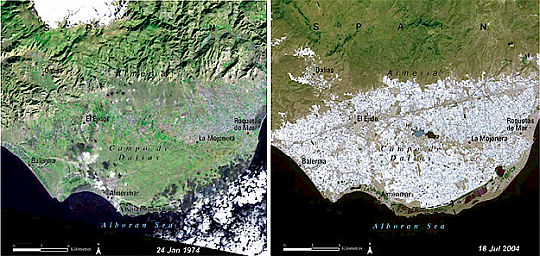
Growth in Almería Greenhouses 1974-2004 |
|
 |
|
| 1974 | 2004 |
| Source: Earth Observatory 2004 Images provided courtesy UNEP/GRID | |
The second phase of the study involved researchers analysing changes in light reflectivity called the albedo effect, using data provided by the Modis Terra satellite and NASA. The results were striking: since 1983, the albedo in the Almería has increased, with 9% more energy reflected into the atmosphere. The landscape has changed from semi-arid scrub to one covered almost exclusively by white plastic, a colour that best reflects the light. Because of changes in land use, the energy balance in the area has decreased by 20 watts per square metre (30 watts in summer), an effect much greater than changes caused by a global warming, an estimated increase of 1.66 watts.
Campra assumes that the study is controversial, but insists that there is no other explanation "with demonstrable evidence." For example, there has been speculation that temperatures may be affected by the Mediterranean sea, but this is not possible because local sea temperatures have risen 0.3 degrees per decade. Campra believes that irrigation water may have had some influence but "drip feed irrigation or hydroponics predominate and evaporation water acts as a powerful greenhouse gas."
There is rich irony in greenhouses raising doubts about greenhouse gases as the main driver of climate change. If greenhouses are the cause of local cooling in Almería, changing global land use, particularly the increase in urbanisation, may have a far greater role in global warming than has been previously realised.