
Nearest Neighbour Analysis
An example of the search for order in settlement or other patterns in the landscape is the use of a technique known as nearest neighbour analysis. This attempts to measure the distributions according to whether they are clustered, random or regular. Nearest neighbour analysis may be used in sand dune vegetation succession studies to test the hypothesis that 'the stone pine woodland forms the climax community'. Here, tree distribution may be expected to be random, rather than the regular pattern expected if the trees had been deliberately planted as part of a sand stabilisation scheme.
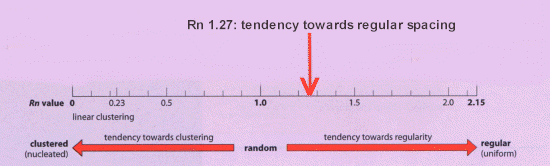
The nearest neighbour formula will produce a result between 0 and 2.15, where the following distribution patterns form a continuum:
|
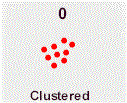
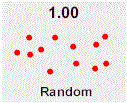
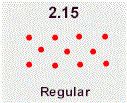
The formula used is as follows:
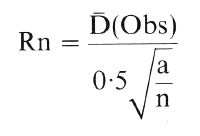 |
|
Key |
|
 |
nearest neighbour value |
 |
mean observed nearest neighbour distance |
 |
area under study |
 |
total number of points |
Methodology
1. Select an area of woodland using random numbers, and mark out a 30m X30m (900m²) quadrat. This should be sufficient to obtain a minimum number of 30 trees (see minimum sample size below).
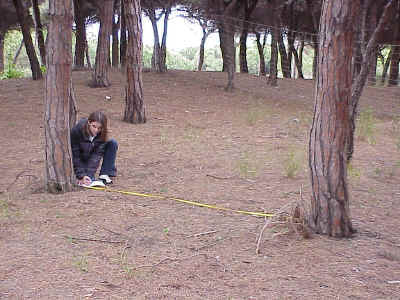
2. Measure the distance of each tree within the quadrat to its nearest neighbour as illustrated below:
 |
3. Apply the above formula.
Example using a 20 x 20m quadrat with 18 trees:
| Tree No. | Distance to nearest neighbour (m) |
| 1 | 4.10 |
| 2 | 5.75 |
| 3 | 3.00 |
| 4 | 3.80 |
| 5 | 3.58 |
| 6 | 3.12 |
| 7 | 2.20 |
| 8 | 2.20 |
| 9 | 3.87 |
| 10 | 2.40 |
| 11 | 2.40 |
| 12 | 3.75 |
| 13 | 4.20 |
| 14 | 1.83 |
| 15 | 3.10 |
| 16 | 0.98 |
| 17 | 0.98 |
| 18 | 2.51 |
| Total | 53.77 |
 |
2.99 |
|
400 m² |
 |
1.27 |
This 1.27 Rn value (which becomes 1.32 when reworked with an alternative nearest neighbour
formula provided by David Waugh) shows there is a tendency towards a regular
pattern of tree spacing.
However, with fewer than 30 trees, it is difficult to to say with any confidence that the distribution has this regular distribution tendency, and the pattern may have occurred by chance. The Rn value lies within the yellow shaded area on the diagram below and therefore has a random distribution at the 95% probability level. The Rn value must lie outside the shaded area before a particular distribution pattern can be accepted as significant.
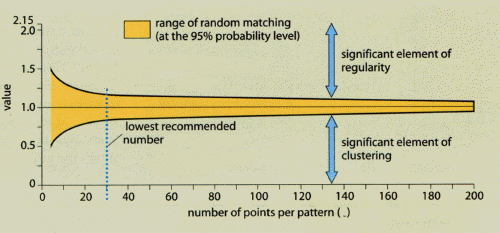 |
Interpretation of Rn statistic: significant values (after David Waugh, with thanks)
Assumptions
1. There has been no new natural pine germination since the planting (if any) of the woodland.