
Expand All  |  Collapse All
 
El Raval
Background
El Raval
Aerial Photographs
Casa Camper Hotel
City Map
City Street Images
Good Practice
Graffiti
History 1000-1859
Immigrant Businesses
Inner city slums
Investment 1988-98
New Developments
Photographs
Raval Hotel
Ravalejar
Raval Rambla
Rebranding Evaluation
Regeneration Issues
Regeneration Model
Representative Areas
Social Changes
Social Cleansing
Social Exclusion
U.K. Cities
Urban Rebranding
Census Data
Average Age
Age Sex 1
Age Sex 2
Births
Census Map
Crime
Deaths
Education
Household Income
Immigration
Land Values
Population Density
Population Origin
Services
Socio-Economic
Coursework
Coursework Planning
Planning
Examples
Planning
Introduction
Data Collection
Data Presentation
Analysis
Organisation
Coursework Helpline
Data Presentation
Bar Graphs
Bi-Polar Graphs
Mapping
Multi-Factor
Pie Charts
Scatter Graphs
Triangular Graphs
Download
Triangular Graphs
Definitions
Quality of Life
Urban Glossary
Kensington School
Introduction
Data Collection
Data Presentation
Analysis
Organisation
Maps
Base Map
Gentrification
Sampling Zones
Transects
Sampling
Problems
Sampling Zones
Techniques
Transects
Random Sampling
Number Generator
Random Numbers
Random Sampling
Statistical Tests
Mann Whitney
Spearman's Rank
Urban Models
Burgess
Core-Periphery
Filtering
Multiplier Effect
Overview
Poverty Cycle
Social Segregation
Socio-Economic
Worksheet Index
Adjective-Pairs
Conflicts Matrix
Environmental
Perceptions
Residential
Services
Regeneration Maps
1988-1998
2002
Study Titles
El Raval
El Raval/Eixample
Urban Rebranding
Casa Camper Hotel
Conflicts Matrix
Inner city slums
Raval Hotel
Ravalejar
Rebranding Evaluation
Social Cleansing
Social Exclusion
Urban Rebranding
Exam Questions
Investigations 1
Home Page
February 8, 2012
Availability | Prices 2011 | Prices 2012
 

Barcelona Inner-city slums

The district known as the Ciutat Vella, or old city, in Barcelona was the entire city until the mid 19th-century expansion. The old city had developed very high housing densities and had associated problems of lack of light, air and open space. As the city expanded, the more well-off population moved out. Slum conditions developed in various areas, and continue to the present day in several neighbourhoods, such as the Barri Gňtic, Santa Caterina and Barceloneta. The highest concentration is found in the neighbourhood known as the Raval, and most specifically Southern Raval.
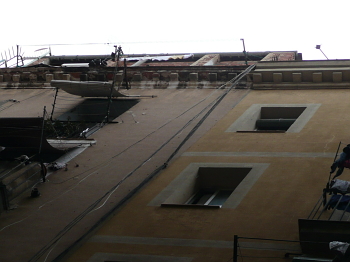
Self-constructed dwellings visible on the roof tops opposite
the Barceló Raval Hotel
Self-constructed dwellings visible on the roof tops opposite the Barceló Raval Hotel

This area was traditionally known as the Barrio Chino, or 'Chinatown', and, partly because of its proximity to the port, has been characterized by marginal activities and the highest levels of poverty in the city. It has also traditionally served as the gateway for new immigrants to the city, providing cheap lodging in very poor conditions, in the form of boarding houses, dormitories and subdivided apartments. The buildings in this area vary in age – some are several centuries old – and the existence of slum lodgings in the area can be traced back at least to the mid 19th century.
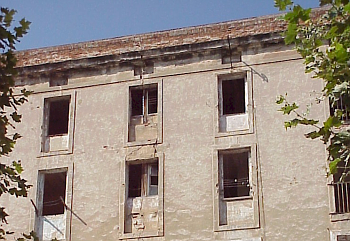
South El Raval: subdivided apartments

Source: THE CHALLENGE OF SLUMS
GLOBAL REPORT ON HUMAN SETTLEMENTS 2003
United Nations Human Settlements Programme

Barceló Raval Hotel: has the Raval exceeded its tourism carrying capacity?


  Copyright © 2012 All Rights Reserved Barcelona Field Studies Centre S.L.  
Page update 26/02/11