
UK Desolate and deserted cities
|
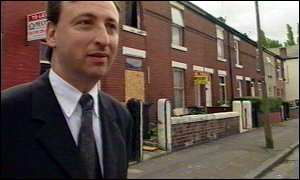
More and more people are moving out ...

The Langworthy estate in the city of Salford is beginning to wear what are seen as the scars of a national trend. Increasing numbers of residents are packing up and moving away - and nobody is moving into the homes they leave behind.
A number of factors including unemployment and escalating crime have resulted in the estate, and the value of its properties, plummeting in desirability.
Local authority tenants simply do not want to be housed there - and some owner occupiers are cutting their losses and abandoning homes that are now worth just a fraction of their purchase price. Almost by the week, another household ups and leaves.
It's the same story in other areas of Salford. Streets of boarded-up, empty terraces are not uncommon.
![[ image: Some householders just cut their losses and abandon homes they cannot sell]](_381353_boarded150.jpg) |
| Some householders just cut their losses and abandon homes they cannot sell |
Others said they had heard of property transactions taking place between individuals in pubs, and being paid for in cash.
Salford city officials are not unaware or inactive about the problems - indeed, the city council's deputy chief executive Tony Struthers is on the Urban Task Force, and was chairman of the Town Planning Institute last year.
Tuesday's report from the task force - headed by Labour peer Richard Rogers - pinpoints a number of measures to encourage people to return to inner-city areas.
The report was sparked by the country's projected need for a further 4.2m households over the next few years.
Wide-ranging recommendations from the architect include improving the design of buildings, cutting back on traffic congestion and providing tax incentives for those who invest in city areas.
Taking notes from European success stories, his vision is for urban dwellers to enjoy safety and quality of life, without encroaching on the countryside surrounding them.
![[ image: Whole rows of empty houses are not uncommon]](_381353_salford150.jpg) |
| Whole rows of empty houses are not uncommon |
Head of Sheffield Hallam University's Urban and Regional Studies centre, Steve Cocker, explains that because there were too many local authority homes in some areas, situations like the one in Salford are able to occur.
People who are able to buy a home and leave socially excluded areas do so, and because there is a decrease in demand for the housing stock, it stays empty and a downward spiral starts as more people seek to leave an increasingly troubled area.
But, he said, there is a real need to regenerate inner cities, especially in the north of England, where traditional industries have left gaping holes in local economies.
"Most of our investment has been in cities, and the health of our economy is inextricably tied up with the health of our cities," he said.
"And if people are leaving the cities, the people that are left behind are going to be subjected to even greater social exclusion. Those are the three key reasons why we need to address the problems faced by many of our cities."
Bottom line is providing work
He said that while he applauded many of the "common sense" measures outlined in Lord Rogers' report, especially tax incentives for inner city developers, the bottom line was providing work for urban dwellers.
He said: "All the cities that have been highlighted as achieving good things in this report have booming economies.
"No amount of pleasant architecture is going to create communities that people want to live in if they have no work.
"What makes people move is their job. If people had jobs to move to in the cities then they would move back into them."
![[ image: Escalating crime is just one of the factors that makes people want to leave]](_381353_fire150.jpg) |
| Escalating crime is just one of the factors that makes people want to leave |
The report's glaring omission, he said, was a call for training
of urban regenerators. "We need a whole new class of professional," he
said, "To address what is going to be one of the biggest issues of the next
century."
Alan Middleton, co-director of the centre for Public Policy and Urban Change at the University of Central England, said it would be crucial to the future of urban environments to ensure that city dwellers have access to work.
He praised the report, saying it was probably the best on urban regeneration seen in recent years.
But he added: "There's an ever increasing concentration of poverty in inner cities. People living in most deprived areas have the least access to the labour force - ethnic minorities, single parents, the elderly.
"It is important that we look not just at how many of these new households we need to put into cities - but who we are going to put where."
Back in Salford, many of the reports recommendations are already in practice.
The plan to get regeneration cash for Langworthy has involved what is thought to be the biggest consultation exercise carried out with owner occupiers.
Council leader Bill Hinds said: "We know from experience that creating attractive houses makes no difference to local people's lives unless you also look at education, jobs, health and all the other social issues which create a vibrant community.
"It takes a lot of determination from all partners and the
support of the community is vital."